
Planetary Mixers: Drive System Selection, Batch Consistency, and Operational Safety
Selecting a planetary mixer goes far beyond comparing bowl volumes or horsepower ratings. The real performance differentiators lie in the transmission architecture, planetary action geometry, material safety compliance, and long-term reliability under daily production loads. This article explains why gear-driven double planetary mixers outperform belt-driven alternatives for medium-to-heavy doughs and batters, how to verify mixing uniformity across the bowl, and which specifications matter most when evaluating equipment for bakeries, hotels, or food production lines. You will also learn the critical safety and hygiene checks that prevent unplanned downtime, ingredient contamination, or operator injury so the rest of your procurement process can focus on informed, risk-adjusted decisions.
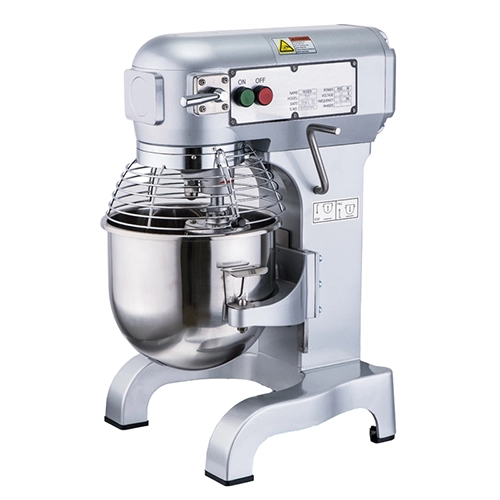
Browse SYBO planetary mixer models
Why the Drive System Matters More Than Horsepower
In commercial planetary mixers, the transmission system directly determines torque consistency, maintenance frequency, and usable lifespan. While many entry-level machines rely on belt drives to reduce manufacturing costs, these systems introduce two inherent weaknesses: belt slippage under high viscosity loads and accelerated wear from thermal cycling.
Gear transmission vs belt drive: a technical comparison
Belt-driven mixers often struggle when kneading stiff doughs with hydration levels as low as 60%. As resistance increases, belts stretch or slip, causing momentary speed fluctuations that lead to inconsistent gluten development. Over time, belt degradation produces rubber particulates, which pose contamination risks in food-sensitive environments.
Gear transmission systems, such as those used in SYBO’s double planetary mixers, eliminate these failure modes. Gears maintain a fixed ratio under full load, ensuring that mixing speed remains stable even when bowl contents transition from low-viscosity batter to high-torque dough. Furthermore, hardened steel gears operating within an oil-bath housing typically achieve 5 to 8 times the service life of comparable belt drives, with no requirement for periodic tension adjustments or belt replacement.
Understanding Double Planetary Mixing Action
The term planetary describes a specific kinematic motion: the mixing head rotates on its own axis while simultaneously revolving around the center of the mixing bowl, similar to a planet orbiting the sun. This dual motion accomplishes what single-axis mixers cannot.
How planetary action eliminates unmixed zones
In a conventional agitator, stationary zones often form near the bowl wall and directly under the hub. A double planetary mixer addresses both:
Self-rotation breaks down localized ingredient agglomerates
Revolution along the bowl wall continuously scrapes and folds material inward
The result is batch-to-batch repeatability. Whether producing macaron batter, mashed potatoes, or heavy cream cheese fillings, the mixing uniformity typically reaches 98% or higher when measured by particle distribution or viscosity sampling across five or more bowl positions.
Practical implications for different viscosity ranges
| Mix Stage | Typical Speed | Application | Key Requirement |
|---|---|---|---|
| 1st speed (low) | ~108 rpm | Kneading dough (60% hydration) | High torque, no belt slip |
| 2nd speed (medium) | ~195 rpm | Batters, salads, mashed potatoes | Smooth fold-in, no aeration |
| 3rd speed (high) | ~355 rpm | Whipping eggs, cream | Fast air incorporation, stable orbitA gear-driven planetary mixer handles all three regimes without mechanical compromise whereas belt drives often show speed droop under 1st-speed dough loads. |
Key Specifications for Commercial Buyers
When evaluating double planetary mixers for bakery, hotel, or restaurant applications, four specifications require particular scrutiny beyond the published brochure values.
Bowl volume vs usable dough capacity
Many suppliers quote gross bowl volume, which can be misleading. The usable capacity for dough is typically 40–50% of gross volume when calculated at 60% water hydration. For example:
A 10L planetary mixer handles approximately 3.2 kg dough (60% water) or 2 kg flour
A 20L model processes roughly 6.4 kg dough or 4 kg flour
These values reflect real-world limits where overloading would strain the transmission or reduce planetary orbit clearance.
Speed ranges and application fit
Three fixed speeds cover 90% of commercial mixing needs:
Low (108 rpm): High-torque dough mixing. Look for gear transmission here, belt drives slip most at low speed under load.
Medium (195 rpm): General batter and semi-solid mixing. Speed stability directly affects texture uniformity.
High (355 rpm): Aeration tasks. Planetary orbit must remain smooth, eccentric wobble at high speed indicates poor hub bearing quality.
Material grade and food safety compliance
All food-contact components should be 304 stainless steel as a minimum. This provides:
Corrosion resistance against acidic batters or salted doughs
Non-porous surfaces that prevent bacterial harborage
Compatibility with standard food-grade sanitizers
For global distribution, verify certificates such as CE, RoHS, LFGB, and REACH depending on target markets. SYBO, for instance, maintains these certifications to meet regional regulatory requirements across Europe, North America, and Asia.
Noise and workplace ergonomics
Despite motor power ranging from 0.45kW to 1.1kW, well-designed planetary mixers with precision-cut gears operate relatively quietly, typically below 75 dB at one meter. This is relevant for open kitchens or front-of-house baking stations where excessive noise negatively affects staff communication and customer experience.
Safety Features: Beyond Basic Guarding
Commercial mixing equipment presents pinch points, rotating shafts, and unexpected start hazards. A compliant planetary mixer must integrate at least two independent safety mechanisms.
Mesh cover with automatic stop
A safety mesh cover prevents operator access during rotation. When opened, an interlock switch immediately cuts power to the motor. Two performance criteria matter:
Response time should stop rotation within 0.5 seconds
Fail-safe design: if the interlock fails, the machine should not start
Bowl-lowering interlock
Many accidents occur when operators reach into the bowl while the agitator is still coasting. A properly designed system stops the motor automatically if the material hopper or bowl support is lowered during operation. This secondary protection addresses the gap between the operator’s action and the machine’s residual rotation.
Hygiene as a safety dimension
Food safety is operational safety. All contact parts made of 304 stainless steel allow for thorough cleaning between batches. Avoid mixers with painted internal surfaces or non-stainless fasteners, as these trap residue and promote biofilm formation over time.
Total Cost of Ownership: Gear Drive vs Belt Drive
Price comparisons that only look at upfront equipment cost are incomplete. A more useful framework considers 5-year TCO including maintenance, downtime, and repair labor.
| Cost Factor | Belt-Driven Mixer | Gear-Driven Mixer (SYBO type) |
|---|---|---|
| Initial cost | Lower ($–$$) | Moderate ($$–$$$) |
| Belt replacement | Every 6–18 months | None |
| Gear maintenance | N/A | Oil change every 2–3 years |
| Speed consistency under load | Drops 10–20% | Stable ±2% |
| Contamination risk | Belt dust possible | None |
| Expected service life | 3–5 years (intensive use) | 10+ yearsFor bakeries running daily 8-hour shifts, the gear-driven planetary mixer typically pays back its higher initial cost within 12–18 months purely through reduced downtime and avoided belt replacements. |
Sourcing, Quality Validation, and Supplier Capability
Evaluating a planetary mixer supplier requires more than reading a datasheet. Based on established exporters like Ningbo Sybo Machinery Co., Ltd. with 25+ years in baking and food equipment, here are the verification steps that procurement managers should follow.
Manufacturing and quality indicators
Geographic advantage: Suppliers located near major export ports such as Ningbo’s proximity to Beilun Ocean Port reduce logistics lead times and coastal freight costs.
Experience profile: 25+ years in food machinery export suggests established quality systems and market-specific knowledge including CE, ETL, RoHS, LFGB, REACH.
Customer references: Look for long-term relationships rather than one-off transactions.
Requestable documentation
Material test reports for 304 stainless steel components
Gear hardness certification typically 55–60 HRC for hardened steel
Interlock switch certification such as IEC 60947-5-1
Test report for speed accuracy under 50%, 75%, and 100% rated load
MOQ, lead time, and private labeling
For B2B buyers:
MOQ: Standard models 10L, 20L typically available from single units; custom colors or branding may require 10–50 units
Lead time: 25–40 days for OEM configurations
Private labeling: Many suppliers offer laser-etched brand names on control panels or side plates
Selection Framework for Planetary Mixers
Implement a four-step process before issuing a purchase order.
Step 1 — Match batch size to bowl volume
Calculate your largest single batch in kilograms. Add 20% margin. Then verify dough capacity at 60% hydration against the supplier’s published data.
Step 2 — Confirm transmission type for your primary application
Mostly dough below 70% hydration: Gear drive mandatory
Mostly batters and creams: Gear drive strongly preferred; belt drive possible but monitor slippage
Whipping/aeration only: Lower torque demands; belt drive may suffice
Step 3 — Verify safety and hygiene certifications
The machine must meet regulatory standards for your target country:
Europe: CE + RoHS + LFGB (food contact)
North America: ETL or UL + FDA food-grade materials
Global export: REACH compliance for chemical substances
Step 4 — Calculate 5-year TCO, not first cost
Include:
One belt replacement per year if belt drive multiplied by labor
Downtime cost per hour multiplied by estimated failure events
Resale value at end of service life, gear drives retain higher value
Key Takeaways
Gear transmission provides stable torque under heavy dough loads; belt drives slip and wear faster.
Double planetary action eliminates unmixed zones through simultaneous rotation and revolution.
Usable dough capacity is typically 40–50% of gross bowl volume at 60% hydration.
Safety requires two independent interlocks: mesh cover and bowl-lowering stop.
304 stainless steel on all contact parts is non-negotiable for food safety.
5-year TCO favors gear-driven mixers despite higher initial price, especially in daily commercial use.
Frequently Asked Questions
What is the difference between a planetary mixer and a spiral mixer?
A planetary mixer’s agitator rotates and revolves, making it suitable for batters, creams, and small dough batches. A spiral mixer uses a fixed bowl and rotating spiral hook, optimized for large dough volumes but poor for liquid batters.
How do I choose the correct bowl size?
Calculate your largest typical batch weight dough or batter. A 10L mixer handles around 3.2 kg dough; a 20L handles around 6.4 kg. Do not exceed 60% of gross bowl volume for dough.
Can a gear-driven planetary mixer handle both dough and whipping?
Yes. Three-speed gear transmission typically 108/195/355 rpm covers kneading, mixing, and whipping without mechanical changeover.
Are planetary mixers safe for daily commercial use?
Yes, provided they include a safety mesh cover interlock and bowl-lowering stop, and all food-contact parts are 304 stainless steel. Regular gear oil changes every 2–3 years maintain long-term reliability.
What certifications should I look for when sourcing from China?
For global markets: CE, RoHS, LFGB food contact, REACH. For North America: ETL or UL. Reputable suppliers like SYBO Machinery maintain these across their product lines.
Why SYBO Machinery
Ningbo Sybo Machinery Co., Ltd., based in Ningbo’s eastern coastal region and located near Beilun Ocean Port, brings over 25 years of export experience in baking equipment, food machinery, and hotel/restaurant equipment. The SYBO brand focuses on gear-driven double planetary mixers built with 304 stainless steel contact parts and multi-certification compliance including CE, RoHS, ETL, LFGB, REACH. With a stated philosophy of customer-first, service-oriented, SYBO emphasizes reliable, cost-effective products and long-term customer relationships.
Need a planetary mixer for your bakery or kitchen?
Request a fitment check, batch capacity recommendation, or bulk pricing.
Browse SYBO planetary mixer models
Download one-page specification comparison table (PDF)