
Wholesale Rotary Convection Oven for Efficient Commercial Baking
Understanding the Heart of Modern Commercial Baking
In the competitive landscape of professional bakeries, patisseries, and high-volume food production facilities, consistent and even heat distribution is the single most critical factor that separates mediocre output from truly exceptional baked goods. Traditional static ovens, with their inherent hot and cold spots, often force bakers into a constant dance of tray rotation, opening and closing doors, and losing precious heat — a compromise that affects product uniformity, texture, and ultimately, profitability. This is where advanced baking technology steps in to redefine operational excellence. A Rotary Convection Oven brings together optimized airflow dynamics and a rotating rack mechanism that entirely removes the guesswork and manual labor from the baking process. By combining a powerful convection system with a slowly revolving trolley, every single pan, regardless of its position inside the chamber, receives identical exposure to the hot air. For bakery owners, this means batch after batch of perfectly uniform bread, pastries, cookies, and muffins without the wasteful variance caused by uneven thermal transfer. SYBO, a trusted name in commercial kitchen equipment, has engineered a series of rotary convection ovens that translate this principle into tangible business growth, delivering precision, energy savings, and durability that seasoned professionals demand.
How Rotary Convection Oven Technology Works
At its core, a rotary convection oven is a sealed baking chamber equipped with a motorized rack — often called a trolley — that constantly rotates around a vertical axis. Simultaneously, a high-output convection fan forces heated air through a network of carefully designed ducts that wrap around the baking zone. This dual-action system creates a maelstrom of circulating hot air that penetrates every tray level horizontally, while the slow rotation of the trolley ensures that each item passes through the most humid and hottest zones in a repeated cycle. Unlike a deck oven where bakers must manually shuffle pans between tiers, the SYBO rotary convection oven maintains a sealed environment; the door stays closed, thermal losses are minimized, and the energy input remains stable. The result is a consistent bake with a 30% to 40% reduction in baking time compared to conventional static ovens, accompanied by a perfectly caramelized crust and uniform crumb structure. SYBO integrates independent top and bottom heating elements controlled via intelligent PID digital thermostats, allowing bakers to fine-tune the heat ratio for specific recipes, whether a dark rye loaf requires aggressive bottom heat or a delicate croissant demands gentle, diffused top heat.
Detailed Technical Specifications of SYBO Rotary Convection Ovens
SYBO manufactures rotary convection ovens in multiple capacities to serve small artisan bakeries as well as large industrial production lines. Below is a detailed table outlining the key technical parameters that equipment buyers and production managers need to evaluate. These specifications reflect the SYBO commitment to industrial-grade construction, using AISI 304 stainless steel interiors, high-density rock wool insulation, and energy-efficient components.
| Model | SYBO-RC-18 | SYBO-RC-32 | SYBO-RC-48 |
|---|---|---|---|
| Tray Capacity | 18 trays (600 x 400 mm) | 32 trays (600 x 400 mm) | 48 trays (400 x 600 mm) |
| Trolley Design | Single rack, 360° rotation | Single rack, 360° rotation | Dual rack side-loading |
| Internal Chamber (WxDxH) | 860 x 1120 x 1780 mm | 1280 x 1560 x 2200 mm | 1560 x 1980 x 2430 mm |
| External Dimensions (WxDxH) | 1320 x 1680 x 2320 mm | 1780 x 2150 x 2740 mm | 2100 x 2680 x 3010 mm |
| Heating Technology | Electric; top & bottom elements | Electric or Gas; independent element control | Diesel/Gas/Electric; intelligent heat recovery |
| Power (Electric models) | 24 kW / 380V / 3-phase | 45 kW / 380V / 3-phase | 72 kW / 380V / 3-phase |
| Temperature Range | Room temp to 300°C | Room temp to 320°C | Room temp to 320°C |
| Convection Fan Motor | 1.1 kW, variable speed | 1.5 kW, variable speed | 2.2 kW, dual fan, variable |
| Steam Injection | Manual, 3-level steam | Automatic steam generator, 2600W | Automatic high-pressure steam, 4000W |
| Insulation Thickness | 100 mm high-density rock wool | 120 mm high-density rock wool | 150 mm double-layer rock wool |
| Control System | PID digital, 10 program memory | 7-inch touchscreen, 50 programs | 10-inch HMI, 100 programs, USB export |
| Safety Features | Overheat protection, door switch, emergency stop | Gas leakage sensor, automatic shut-off | Full safety interlocks, fire suppression ready |
| Net Weight | 680 kg | 1150 kg | 1980 kg |
Beyond the table, there are additional engineering details that set SYBO apart. All models feature reversible door swing, integrated exhaust hoods, and dual-layer heat-resistant glass observation windows with interior lighting. The heavy-duty castors on the trolley ensure smooth loading and unloading, while the oven floor is reinforced to withstand constant trolley entry without deformation over decades of use.
Key Benefits That Transform Bakery Operations
- Perfect Uniformity Without Manpower: The continuous rack rotation eliminates the need to open doors and swap trays. The SYBO rotary convection oven delivers identical color and moisture content across all 18, 32, or 48 trays in a single cycle, slashing rework and waste.
- Dramatic Time Savings: The aggressive air circulation and rotating exposure reduce baking times by up to 40% compared to deck ovens. A full load of crusty baguettes that might take 25 minutes in a static oven finishes in roughly 15 minutes inside an SYBO unit.
- Moisture Control & Steam Integration: Controlled steam injection in the initial phase creates a glossy, crisp crust on artisan breads. SYBO ovens offer programmable steam cycles that do not disrupt chamber temperature, resulting in perfect oven spring and blistering.
- Floor Space Optimization: Instead of stacking multiple deck ovens, a single rotary convection oven with a 32-tray capacity occupies a compact footprint while delivering the output of three separate modules, freeing up valuable square footage for other production stages.
- Energy Efficiency and Lower Utility Bills: Thanks to superior insulation and a sealed design, SYBO rotary convection ovens consume up to 25% less energy per kilogram of baked product than older generations. The fast baking cycle also means less cumulative kilowatt-hour usage per day.
- Versatility Across Product Categories: Breads, croissants, muffins, cheesecakes, whole chickens, and even granola can be processed in the same SYBO oven. The wide temperature range and customizable program banks allow bakers to switch between sweet and savory with zero flavor crossover.
Why SYBO Stands Out in the Commercial Oven Market
SYBO has spent over a decade refining rotary convection oven design specifically for the harsh demands of 24/7 production environments. The brand does not simply assemble generic components; every SYBO oven is built around heavy-gauge stainless steel frames, industrial-grade German-brand circulation fans, and proprietary air baffle geometry that creates laminar airflow around each tray. This meticulous engineering prevents the common problem of tray-edge burning while the center remains underbaked. Additionally, SYBO’s after-sales commitment includes commissioning support, on-site training for bakery teams, and a global network of parts warehouses. The proprietary steam generator, which uses a submerged heating element inside a corrosion-resistant boiler, is maintenance-friendly and prevents the mineral buildup that plagues many competitor models. For chains and commissaries requiring process validation, SYBO also provides HACCP-compliant temperature logging and remote monitoring capability on higher-end models.
Application Across Bakeries, Hotels, and Central Kitchens
The SYBO rotary convection oven series is equally at home in an artisan bread shop, a supermarket in-store bakery, or a massive flight kitchen. For artisan breads, the gentle rotation mimics the evenness of a wood-fired hearth without the manual stoking. In patisseries, the precise steam and variable air speed prevent delicate laminated doughs from collapsing. High-volume pita bread and tortilla lines benefit from the rapid cycle times; operators can easily program a “flash bake” mode at maximum temperature with high steam for the puffing effect. Even protein roasting — such as rotisserie-style chicken without spits — comes out evenly browned and juicy in the SYBO oven, expanding menu potential for hotels and catering companies.
FAQ About the Rotary Convection Oven
What exactly is a rotary convection oven and how does it differ from a standard convection oven?
A rotary convection oven incorporates a carousel-like rack that continuously turns the entire load of products inside the baking chamber, while powerful fans circulate hot air all around. A standard convection oven relies solely on fans to move air, but trays remain static, leading to potential uneven airflow patterns near the back or near door corners. Because the SYBO rack rotates, each tray goes through every thermal zone in the chamber, guaranteeing identical baking conditions on the top, middle, and bottom shelves. This eliminates the need for pan swapping and provides unmatched batch-to-batch consistency.
How do I determine the right tray capacity and size for my bakery when choosing an SYBO rotary convection oven?
Start by calculating your peak production volume per hour and the size of your standard sheet pans. Most bakeries use 600 x 400 mm trays, which the SYBO-RC-18 and SYBO-RC-32 accommodate. If you currently use a single deck oven and find yourself baking in multiple shifts, an 18-tray rotary oven often replaces two or three deck ovens. For wholesale or commissary bakeries outputting thousands of rolls per hour, the 32-tray or 48-tray models are essential. SYBO consultants can help you match model to your throughput goals by analyzing your recipe bake time, desired daily output, and available floor layout.
Is gas or electric heating better for a rotary convection oven, and does SYBO offer both?
Both heating types have merit depending on local utility costs and available infrastructure. Electric SYBO rotary convection ovens offer rapid heat-up, pinpoint temperature accuracy, and simpler installation. Gas-fired models can be more economical to operate in regions with low natural gas prices and are favored for large bakeries with high daily throughput. SYBO manufactures dual-fuel and gas-only versions of the RC-32 and RC-48. Gas ovens from SYBO use an indirect heat exchanger system so combustion gases never contact the baking chamber, preserving food purity. The control system seamlessly manages safety interlocks including flame detection and automatic ignition.
What maintenance does an SYBO rotary convection oven require, and can it be serviced easily?
Preventive maintenance is straightforward and designed for minimal downtime. Daily tasks include wiping the glass, checking trolley wheel smoothness, and inspecting the door gasket for tears. Weekly, bakers should clean the steam generation nozzle and remove any flour or debris around the fan guard. Quarterly, a qualified technician should inspect the heating elements, tighten electrical connections, and verify the rotation motor alignment. SYBO ovens use modular components mounted on slide-out trays, so replacing a fan motor or a heating element can be done through the front service panel without moving the heavy oven. A full maintenance guide is included, and SYBO supports customers with tutorial videos and responsive technical assistance.
Can I bake multiple product types simultaneously in a SYBO rotary convection oven?
Yes, and this is one of the major productivity gains cited by bakery owners. Because the oven delivers uniform heat to every tray position, you can load croissants on the upper half and bread rolls on the lower half without flavor transfer, provided both products require similar temperature and steam parameters. For example, a 200°C bake for both soft buns and tea cookies works perfectly. If the recipes demand different steam or fan speeds, SYBO touchscreen models support multi-phase programming where you can pause the trolley to unload one product halfway while the remainder continues, all without aborting the cycle. This flexibility reduces idle oven time drastically.
How does SYBO ensure the safety and durability of its rotary convection ovens in a high-humidity, high-heat kitchen?
Durability is engineered at the material and design level. The entire oven interior is crafted from 2.0 mm thick AISI 304 stainless steel, which resists corrosion from steam and acidic bakery ingredients. All seams are continuously welded and polished to prevent buildup. The insulation uses multiple layers of compressed rock wool with an aluminium foil vapor barrier, preserving heat and structural integrity over decades. Electronics housing is sealed against moisture ingress and actively ventilated. On gas models, the flue gas circuit includes a stainless steel heat exchanger with test ports for combustion analysis. SYBO’s safety system interrupts operation if any access panel is opened, if temperature exceeds safe limits, or if rotation fails, preventing product fires and equipment damage.
What kind of steam system does the SYBO rotary convection oven use, and why is it important?
Steam is critical for artisan breads; it delays crust formation, allowing maximum oven spring and a shiny, crackled crust. SYBO uses a dedicated, low-pressure steam generator plumbed directly into the oven cavity. This generator features an independent water reservoir, a durable incoloy heating element resistant to scale, and a fine mist injection nozzle. Unlike simple splash systems, the SYBO generator turns water into dry or saturated steam on demand according to the recipe phase. This ensures the chamber does not experience temperature dips when steam is injected, preserving the thermostat consistency. The system includes an automatic drain and a filter to mitigate hard-water issues, prolonging element life.
How long does installation typically take, and what site preparation is needed?
For a bakery with a level floor, adequate 3-phase electrical supply, and the proper exhaust flue location, a professional installation of an SYBO rotary convection oven can be completed in one to two days. Site preparation requires verifying that the floor can bear the oven’s weight, ensuring clearance for the trolley path and door swing, and providing a dedicated circuit breaker per the specification plate. Gas models also require a certified gas line connection and a pressure regulator. SYBO ships a detailed pre-installation checklist, and the oven arrives fully assembled and factory-tested on a pallet. After connection, an SYBO technician or a trained local partner performs commissioning, calibrates the PID controller, and runs a full baking test to train the staff.
Is it possible to get spare parts quickly for SYBO ovens internationally?
Yes. SYBO maintains strategic parts warehouses in key regions including North America, Europe, Southeast Asia, and Australia. Common wear items such as door gaskets, fan belts, heating elements, and temperature probes are stocked locally with most orders shipped within 24 hours. For rarer components, express international courier options are available. All SYBO exclusive parts are documented with exploded diagrams and part numbers in the service manual. The company also offers extended warranty and service plans that include priority parts dispatch and annual preventative maintenance visits by a certified technician.
Optimizing Your Baking Workflow with the Right Rotary Convection Oven
Integrating an SYBO rotary convection oven into a production line isn’t just about purchasing hardware—it’s about transforming workflow. The removable trolley system allows bakers to load an entire rack of proofed dough in the proofer and then transfer it seamlessly into the oven without handling individual pans. This drastically reduces labor hours and the risk of degassing delicate dough. Combined with programmable multi-stage baking, bakers can program an initial steam phase, a high-heat crust-setting phase, a mid-bake temperature reduction for even crumb set, and a short venting phase to dry out steam before unloading. Such precision is unattainable with manual ovens and is what gives SYBO-equipped bakeries a competitive edge in product quality and operational consistency. The oven’s rapid recovery time between batches also means that even a small bakery can increase daily throughput by 50% without hiring additional staff.
- View as
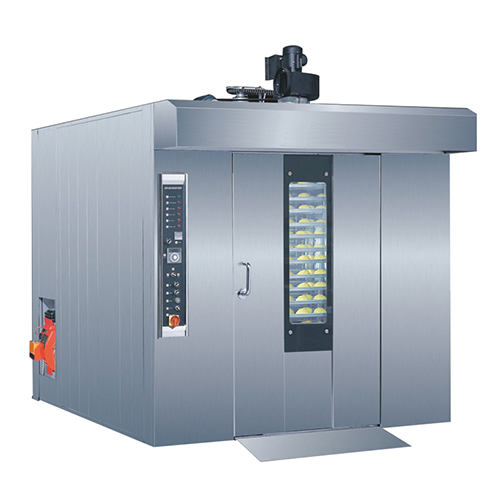
Diesel Rotary Convection Oven
For bakery factories and central kitchens looking to cut daily electricity costs, our SYBO diesel rotary convection oven is a practical heavy-duty baking solution. This fuel-powered rotating oven runs on diesel, which is much cheaper and easier to access in most industrial areas. It is widely used for mass production of bread, pastries, biscuits and other baked goods.
Read MoreSend Inquiry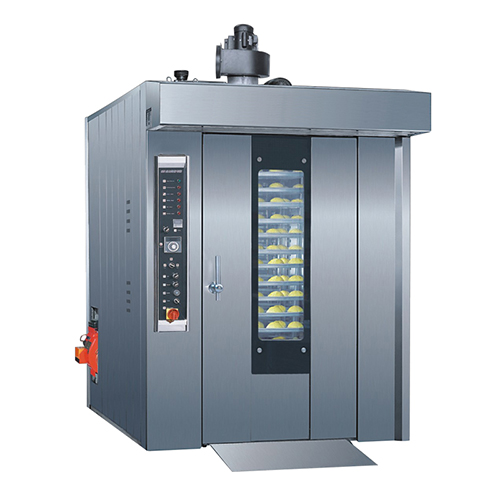
Electric Rotary Convection Oven
For large bakeries, food factories and commercial catering plants that need high-output baking, the SYBO electric rotary convection oven is built for heavy-duty daily production. This industrial rotating oven is one of our best-selling bakery machines, designed for consistent mass baking with stable temperature and low energy consumption.
Read MoreSend Inquiry
SYBO is a professional Rotary Convection Oven manufacturer and supplier in China. We warmly welcome you to wholesale high quality products at competitive price from our factory.