Commercial Pizza Dough Roller
Commercial Pizza Dough Roller by SYBO turns 50–500g dough balls into 100–400mm bases at 0.5–5.5mm thick. Built by a 25-year Ningbo manufacturer in stainless steel and food-grade resin, it replaces hand rolling with bases that bake the same every shift.
Send Inquiry
Product Description
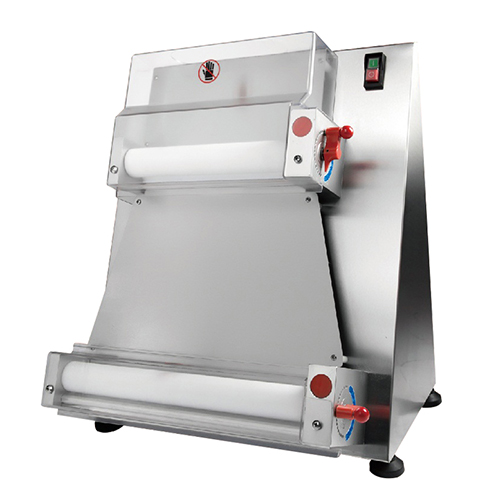
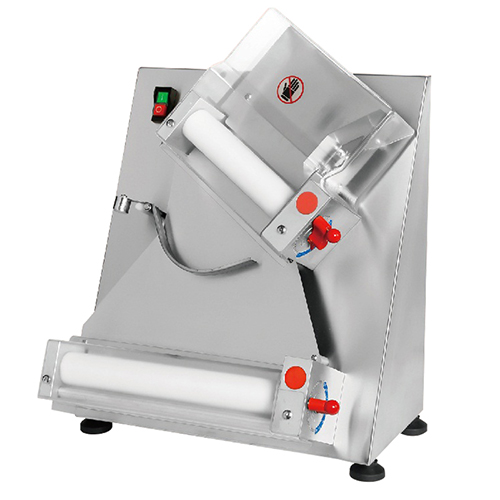
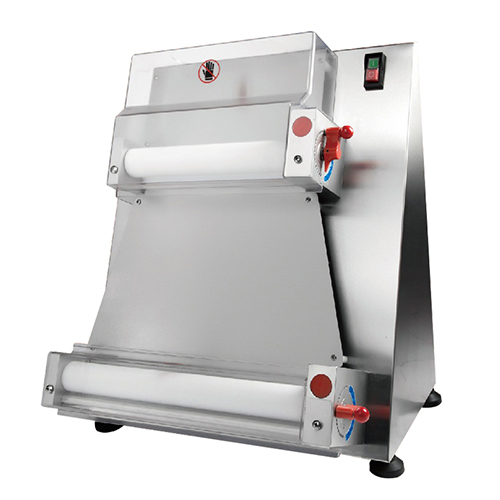
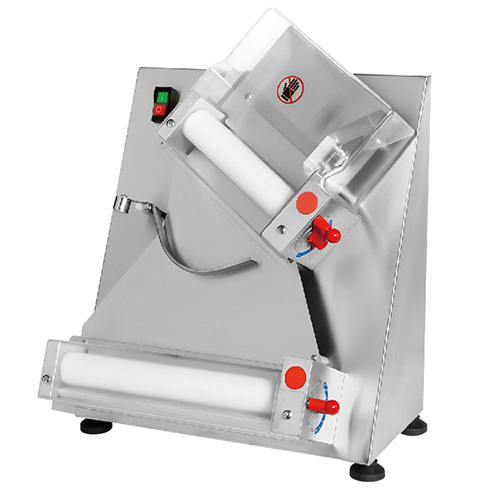
Hand rolling is the slowest step in a pizza kitchen and the hardest one to keep consistent: two chefs, two dough balls, two different bases. Ningbo Sybo Machinery Co., Ltd., trading worldwide as SYBO, is a Ningbo manufacturer with more than 25 years of commercial bakery and kitchen equipment behind it, and the Commercial Pizza Dough Roller is the machine it builds for exactly that bottleneck. A rested dough ball goes in at the top, two rollers and a transparent acrylic guard carry it down to a preset thickness, and a flat round base comes out ready for topping, the same size and the same thickness as the one before it.
- 50–500 gDough ball range
- 0.5–5.5 mmAdjustable thickness
- 100–400 mmBase diameter
- CE & RoHSCertified range
What It Does
This is a semi-automatic flattening machine rather than a full production line. An operator places the dough, the rollers draw it through, and it exits as an evenly thick sheet. Three things define what it does.
- Dough balls in, flat bases out. Balls between 50 g and 500 g pass between two food-grade rollers and come out as a uniform sheet, ready to be opened to size and topped.
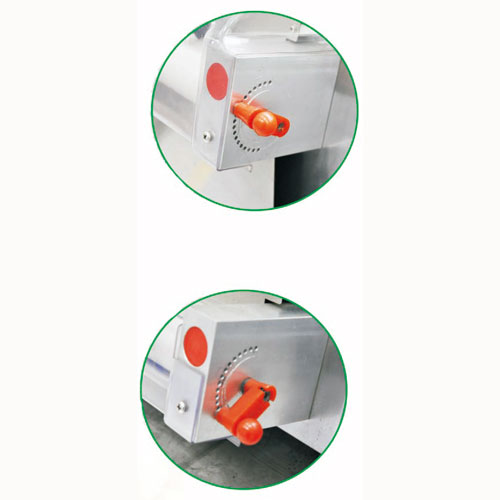
- One dial sets the thickness. The orange knob on the side moves the roller gap from 0.5 mm to 5.5 mm, so the same machine produces cracker-thin Roman-style bases and thicker American pans without changing parts.
- Flatbreads and pastry as well. Beyond pizza, it handles pita, focaccia and other soft flat doughs, which saves a small kitchen from buying and storing a second piece of equipment.
In short, the Commercial Pizza Dough Roller takes the one step in the kitchen that depends most on individual skill and turns it into a setting on a dial.
Key Advantages
Operators rarely choose on price alone. These are the five points that come up most often once a machine has been through a few months of real service.
- Even thickness, batch after batch. Because the gap is set mechanically rather than by hand, every base from a 500 g ball comes out at the same thickness, so baking times stop drifting and the finished pizza looks the same on every table.
- Food-grade materials where they matter. The white rollers are food-grade resin, the contact frame is stainless steel, and the guard over the working gap is transparent acrylic, so nothing reactive touches the dough.
- Overload protection on the motor. If an oversized ball or a hard foreign object strains the rollers, the protection device cuts the power automatically instead of burning out the motor.
- A guard that keeps hands clear. The acrylic cover encloses the gap between the rollers, which means no fingers near a moving surface and less flour dust settling on the mechanism.
- A bench footprint, not a floor plan. The DR-2A measures 495×490×640 mm and the DR-1V 540×550×650 mm, so either model sits on a standard prep bench beside the dough trays.
Taken together, those five points mean the Commercial Pizza Dough Roller removes the two things a kitchen cannot plan around: inconsistent bases and the hours lost to hand rolling.
Specifications
Both models run on the same motor, the same roller material and the same thickness control. The real difference is how wide a base each one can produce and how much bench space the frame needs.
Models and Sizes
| Model | Voltage | Power | Dough Weight | Base Diameter | N.W. / G.W. | Dimensions (L×W×H) |
|---|---|---|---|---|---|---|
| DR-2A | 220V, 50/60Hz | 0.37 kW | 50–500 g | 100–300 mm | 35 / 49 kg | 495×490×640 mm |
| DR-1V | 220V, 50/60Hz | 0.37 kW | 50–500 g | 100–400 mm | 42 / 57 kg | 540×550×650 mm |
Packed dimensions are 580×560×730 mm for the DR-2A and 630×600×740 mm for the DR-1V, both on export cartons built for sea freight.
Build and Materials
- Body and frame — stainless steel with acrylic side panels, resistant to corrosion and to the flour and moisture of a working bakery.
- Rollers — white food-grade resin, enclosed behind a transparent acrylic cover that protects the operator and the working gap.
- Thickness control — a single orange side knob, adjustable from 0.5 mm to 5.5 mm, with no tools and no parts to swap.
- Motor — 0.37 kW with an automatic overload cut-off, sized for continuous daily use rather than occasional hobby output.
Voltage: 220V, 50/60Hz as standard. Buyers operating on 110V or other supplies should raise this at the enquiry stage so the machine is configured before it leaves the factory.
Between the shared motor, the single thickness dial and the compact frame, the Commercial Pizza Dough Roller fits a bench rather than a production floor, and needs no reconfiguration to switch styles.
Who It Fits
The machine suits any operation that produces pizza or flatbread in steady daily volume but does not want to run a full sheeting line.
- Independent pizzerias and takeaway shops — one unit replaces the most time-consuming and least consistent job in the kitchen, and it can be worked by a single operator during a rush.
- Pizza chains and multi-site groups — a mechanical thickness setting is the simplest way to make base quality identical across sites, whatever the experience of the local staff.
- Bakeries, cafes and sandwich shops — a flatbread, focaccia or pastry line can be added without buying a separate sheeter.
- Hotel and central kitchens — steady output for breakfast and banquet service, with no dependency on a specialist chef being on shift.
- Importers and equipment distributors — CE and RoHS certification, bulk pricing, export cartons and mixed-model loading for container orders.
For all of them, the Commercial Pizza Dough Roller answers the same question: how to produce a consistent base without a skilled hand on every single dough ball.
Safety & Service
On a food-contact machine that runs through a full shift, safety and support matter as much as output. Four things are worth checking before the order is placed.
- Automatic overload cut-off. When the motor is strained by a jammed ball or a hard object, the device cuts the power instantly, which protects the motor and reduces the chance of injury to the operator.
- A guard over the working gap. The transparent acrylic cover keeps hands away from the rollers and lets the operator watch the dough feed without lifting anything.
- Certification that clears customs. CE and RoHS approvals are held across this equipment range, which supports food-safety and import review in most destination markets.
- Parts, documents and warranty. Warranty terms, spare rollers and control parts supply, and return rules are confirmed in writing with every quotation, and specification sheets and packing lists are issued before shipment.
Support continues after delivery. Setup is unpacking and plugging in, and cleaning, thickness adjustment and daily care are covered by written instructions and short video walk-throughs. Sample units and pre-shipment inspection can be arranged before a bulk order is confirmed, and larger projects can be discussed with custom packaging or voltage configuration.
Buyers who have to justify the decision to a manager or an importer can point to the Commercial Pizza Dough Roller and find the certificates, the drawings and the spare-part path already in hand.
FAQ
Q and A — the questions buyers ask most often before a first order is placed.
Q: What dough weight and base diameter can it handle?
A: Both models accept dough balls from 50 g to 500 g. The DR-2A flattens them into bases between 100 mm and 300 mm across, while the DR-1V reaches 400 mm for large and family-size pizzas. Dough should be rested and close to room temperature; very cold or heavily oiled doughs feed through less evenly.
Q: How thin can the bases go, and how is that adjusted?
A: From 0.5 mm to 5.5 mm. A single orange knob on the side sets the gap between the rollers, so an operator can move from a thin Roman-style base to a thicker American pan without tools or spare parts. It is worth pressing one test ball after any adjustment, because different flour blends relax at slightly different rates.
Q: Which model should a busy pizzeria choose, DR-2A or DR-1V?
A: Choose by the largest base on the menu. If nothing goes past 300 mm, the DR-2A is the lighter and more compact option at 35 kg net and 495×490×640 mm. If the menu includes 400 mm bases, the DR-1V is the only fit, at 42 kg net and 540×550×650 mm. Both share the same motor, roller material and thickness range.
Q: Can staff clean it easily between shifts?
A: Yes. The acrylic cover lifts clear and the dough-contact surfaces are smooth, so a wipe-down with a damp cloth and a food-safe sanitiser covers routine cleaning at the end of a shift. Unplug the machine first, and never pour water over the motor housing or the control area.
Q: What happens if dough catches in the machine?
A: A built-in protection device cuts the power automatically when the motor is strained, for example when an oversized ball or a hard foreign object reaches the rollers. That prevents the motor from burning out and reduces the risk of injury to the operator. Switch off and unplug the unit, clear the blockage by hand, then restart as normal.
Q: What is the minimum order quantity, and are samples available?
A: A single unit can be supplied as a sample so the base quality and the build can be checked directly. Bulk pricing, carton quantities and mixed-model orders are quoted on request, and specification sheets are issued before an order is confirmed.
Hot Tags: Commercial Pizza Dough Roller
Related Category
Planetary Mixer
Spiral Mixer
Dough Sheeter
Dough Divider Rounder
Convection Oven
Rotary Convection Oven
Deck Oven
Proofer
Bread Slicer
Pizza Oven
Send Inquiry
Please Feel free to give your inquiry in the form below. We will reply you in 24 hours.
Related Products