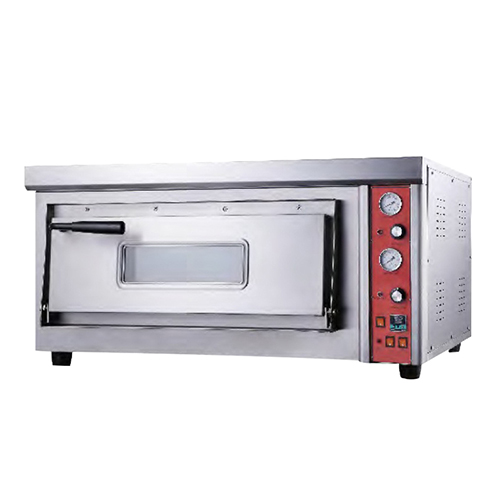
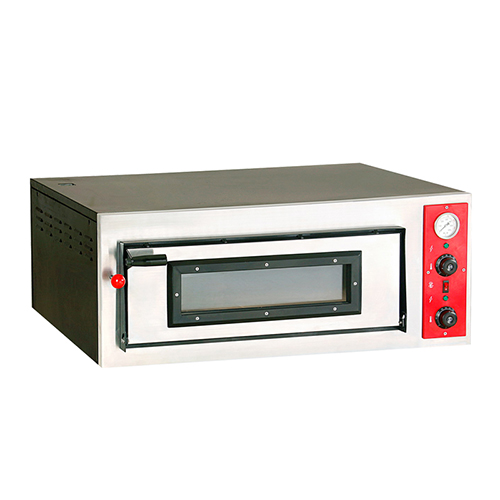
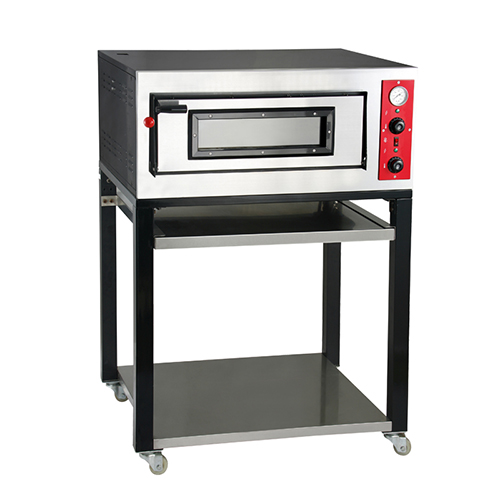
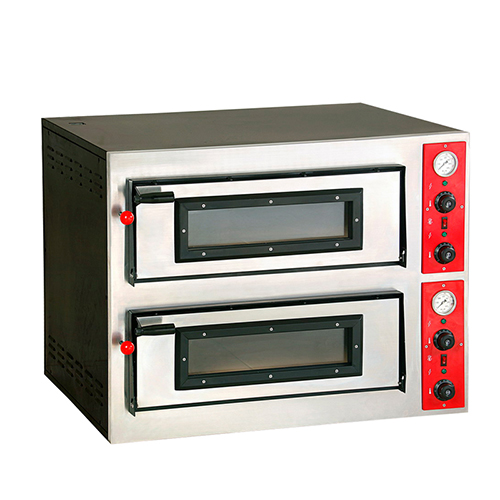
Electric Pizza Oven
Electric Pizza Oven by SYBO bakes 4 to 12 twelve-inch pizzas per load on a stone deck reaching 450°C. Built by a 25-year Ningbo factory, the EPZ series runs 4.5 to 13.8 kW, splits top and bottom heat, and holds crust quality through any dinner rush.
Send Inquiry
Product Description
A pizza oven is judged in the middle of a Saturday service, not on a spec sheet: the door opens, the deck has cooled a little, and the next eight bases still have to come out with the same colour on top and the same crispness underneath. That consistency is what Ningbo Sybo Machinery Co., Ltd., trading as SYBO, builds its stone-deck machines around. With more than 25 years in commercial baking and catering equipment behind it, the company offers the Electric Pizza Oven as a four-model range spanning 4 to 12 pizzas per load. In place of an open flame it uses a refractory stone deck, a high-density insulated chamber and separate electronic control of top and bottom heat, so the interior behaves as a sealed baking chamber that holds its temperature rather than a cavity an operator has to fight with.
- Up to 450°CStone deck temperature
- 4 to 12 PizzasPer load, by model
- Independent HeatSeparate top and bottom zones
- 304 StainlessBody and chamber
What It Does
An electric commercial pizza oven is a heat-storage machine rather than a heater. The chamber is lined with firebrick, the controls build temperature up to 450°C, and the brick then radiates that heat into the base of the dough. Once it is at working temperature it holds there, which is the difference between a pizzeria that survives a rush and one that starts apologising for pale crusts at eight o'clock.
Three things define what a stone-deck machine does in a working kitchen.
- Refractory stone baking. The base of each pizza rests on a firebrick deck rather than a metal tray, so heat enters the dough directly. That is what produces a crisp underside with a tender, airy crumb instead of the pale, slightly steamed base a rack or a conveyor belt tends to give.
- Independent top and bottom heat. The two circuits are set separately on the digital panel. A thin Neapolitan base at high bottom heat browns fast without drying the cheese, while a heavy American pan build takes more top heat so the centre sets before the crust catches. One oven, two very different styles.
- Batch capacity that scales with the menu. The chamber footprint is what sets output: one deck taking four 12-inch pizzas, one deep deck taking six, two stacked decks taking eight, and two deep decks taking twelve. All four share the same stone deck, the same 50°C to 450°C range and the same control logic.
The result is a fixed piece of equipment that turns dough, sauce and topping into consistent product at a predictable rate, whatever the experience of the person working the peel. That steadiness is the whole point of an Electric Pizza Oven: the machine holds the conditions, so the operator only has to load and unload.
Core Advantages
Five design decisions separate a machine that is pleasant to own from one that becomes a source of complaints in year two.
- A body built for a commercial kitchen. The chamber and shell are 304 stainless steel, which shrugs off the grease, flour dust and daily wiping that kills painted or thin-gauge housings. Surfaces are smooth, so routine cleaning is a wipe-down rather than a disassembly job.
- A high-density insulation layer. Because the chamber is heavily insulated, the outer shell stays comparatively cool even after hours of continuous service. The kitchen stays workable, less heat is wasted into the room, and the running cost comes down with it.
- Electronic heat control, not a dial and a guess. Digital thermostats hold the chamber where it is set instead of drifting. Between that and the separate top and bottom zones, an operator can reproduce a bake consistently across shifts and across staff.
- Visibility without opening the door. An interior light lets the operator watch a bake colouring through the door glass. That matters more than it sounds: every time the door is opened to check, the chamber loses heat and the next pizza in pays for it.
- Four sizes on one platform. A private bakery ordering four pizzas at a time does not have to buy the same capacity as a central kitchen doing twelve, and neither has to learn a different machine, because the operation and the deck material are identical across the range.
Taken together, that is an oven sized to the operation, insulated well enough to run all day, and controlled closely enough that the output stops depending on who is standing in front of it. Each of those points is a direct answer to the way an Electric Pizza Oven fails when it is bought badly.
Specifications
All four models share the same 50°C to 450°C range and the same firebrick deck. What changes is chamber volume, electrical load and weight. Note that the three larger models are three-phase machines, and the EPZ-4 is single-phase.
Technical Data
| Model | Voltage | Power | Chamber Size | Pizza Capacity | Dimensions (L×W×H) | Net Weight |
|---|---|---|---|---|---|---|
| EPZ-4 | 220–240V / 380V | 4.5 kW | 660×660×135 mm | 4 × 12" | 975×945×415 mm | 100 kg |
| EPZ-6 | 380–415V | 6.9 kW | 660×990×135 mm | 6 × 12" | 975×1230×415 mm | 119 kg |
| EPZ-8 | 380–415V | 9.0 kW | 660×660×135 mm × 2 | 8 × 12" | 975×945×745 mm | 135 kg |
| EPZ-12 | 380–415V | 13.8 kW | 660×990×135 mm × 2 | 12 × 12" | 975×1230×745 mm | 217 kg |
All models: 50–450°C range, refractory stone deck, 304 stainless steel body, digital top and bottom heat control, interior door light. The EPZ-4 can be built for 220–240V single phase or 380V; the EPZ-6, EPZ-8 and EPZ-12 are three-phase 380–415V as standard. Confirm your supply before ordering.
The practical reading of that table is a straight capacity decision. If the largest order on the menu is four pizzas, the EPZ-4 delivers it from a single-phase supply in a footprint under a metre wide. Move to six or more and the choice becomes about which deck layout fits the counter, because the two sizes of chamber and the single or double stack cover the rest. Whichever model is chosen, the Electric Pizza Oven keeps the same deck material and the same control logic.
Configurations at a Glance
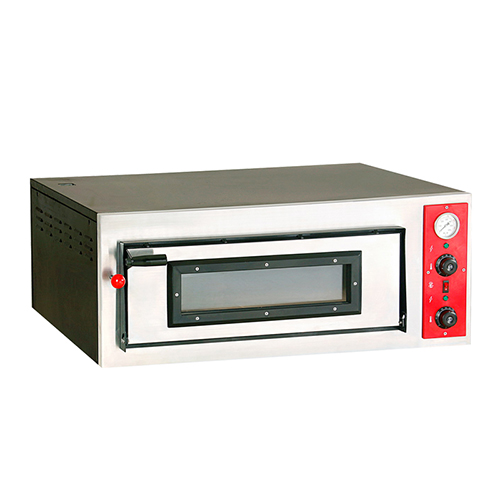
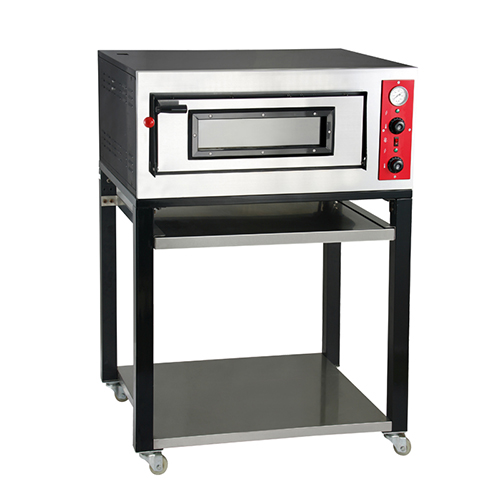
- EPZ-4 — one deck, four pizzas, 4.5 kW, single phase available. The entry point for low-volume production.
- EPZ-6 — one deep deck, six pizzas, 6.9 kW. The same footprint height as the EPZ-4, wider chamber.
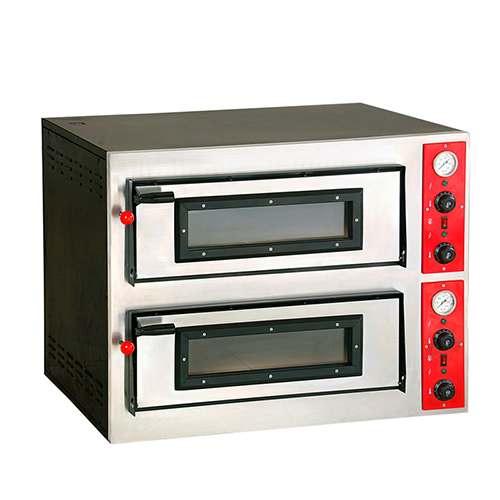
- EPZ-8 — two stacked decks, eight pizzas, 9.0 kW. Two independent chambers in the footprint of one.
- EPZ-12 — two stacked deep decks, twelve pizzas, 13.8 kW. The largest single-unit capacity in the range.
Where It Fits
The right model is decided by peak order volume, by how much counter or floor space is available, and by whether the site can support a three-phase supply. In practice that resolves into a handful of typical operations.
- Private bakeries and home-style kitchens — the EPZ-4 matches small-batch production where a four-pizza load is a full order, and it can run from a single-phase supply.
- Small and mid-size pizzerias — the EPZ-6 is the workhorse. A deep deck that takes six pizzas absorbs a normal dinner rush without the operator standing over it.
- Pizza chains and food courts — the EPZ-8 puts two independently controlled chambers in one footprint, so two styles or two products bake side by side.
- Catering and central kitchens — the EPZ-12 produces twelve pizzas per load for batch production, par-baking and large-format events.
- Bakeries, cafes and western restaurants — the same chamber bakes bread, tarts, baked pasta and oven snacks, so it earns its space on more than one menu line.
- Importers and equipment distributors — the four-model range, export packing, documentation and mixed-model container loading suit distributors serving a region rather than a single site.
Where an electric oven is the right answer is a site with a stable supply, where the kitchen wants the flavour of stone-deck baking and a fixed, predictable running cost. In a location where the supply is weak or unstable, or where a very fast heat-up is the priority, a gas-fired machine is normally the better fit, which is why SYBO builds both and will advise on the choice rather than push one. The deciding test is simple: an Electric Pizza Oven rewards a site that has the power and wants the consistency.
Build & Support
An oven is a long-life purchase, so the parts behind it matter as much as the specification in front of it.
- Components selected for continuous duty. Heating elements, digital controllers and safety components are industrial-grade rather than consumer parts, because these machines are specified for continuous use rather than occasional baking.
- Tested before it ships. Every unit runs a temperature-control and continuous-load test before it leaves the factory, so what arrives is a chamber that has already been through a heating cycle.
- Selection advice before the order. Model choice, single-phase or three-phase, chamber layout and product mix are reviewed with the buyer in advance, which prevents the most expensive mistake in this category, which is buying the wrong size.
- Documentation and after-sales path. Installation and commissioning guidance, operating instructions and a clearly stated warranty and spare-parts route come with the machine, and larger projects can be discussed with custom voltage or chamber requirements.
Support continues after delivery. Installation is a matter of positioning, connecting the supply and running a first heat cycle, and both are covered in the written instructions supplied with each unit. Commissioning guidance and operating questions are handled through the same channel as the original enquiry, and specification sheets, drawings and photographs can be supplied before an order is placed so the site can be prepared in advance.
For anyone who has to justify the decision to a manager, a financier or an importer, the useful part is that the specification is published in full: chamber dimensions, electrical load, capacity and weight are stated openly, and the Electric Pizza Oven can be matched to a measured requirement rather than sold on a claim.
Certification & Export
CE and RoHS approvals are held across the range, which covers the safety and materials requirements most import markets ask to see. Units are packed on export cartons suited to sea freight and ship from Ningbo, next to Beilun Ocean Port, so freight arrangements and lead times are straightforward. Buyers can work with their own forwarder, or ask SYBO to arrange freight and export documentation.
FAQ
Q and A — the questions buyers ask most often before a first order is placed.
Q: Which model should I choose for my production volume?
A: Choose by the largest number of pizzas you expect to bake at one time, then confirm the supply. The EPZ-4 handles four 12-inch pizzas from a single-phase supply. The EPZ-6 takes six on one deep deck. The EPZ-8 stacks two decks for eight. The EPZ-12 stacks two deep decks for twelve. If your peak load is six or more, plan for a three-phase supply, because the EPZ-6, EPZ-8 and EPZ-12 are three-phase machines.
Q: What temperature does it reach, and how long does it take to heat up?
A: The chamber range is 50°C to 450°C, with 450°C representing full stone-deck heat for thin-crust and high-temperature baking. Heat-up time depends on the model and on the ambient temperature of the kitchen, so the practical approach is to switch the unit on at the start of prep and let the refractory deck come up to working temperature before the first bake. Once it is hot, the insulation layer is what keeps recovery times short between loads.
Q: Can I bake anything other than pizza in it?
A: Yes. Bread, tarts, baked pasta dishes and oven snacks all bake normally once temperature and time are adjusted, and the two stacked models can hold two different temperatures at once. What it is not suited to is anything needing steam injection or a controlled humidity cycle, which requires a dedicated bread oven rather than a stone-deck pizza chamber.
Q: How is it cleaned, and how often?
A: The stainless steel surfaces are wiped down with a damp cloth and a food-safe cleaner at the end of a shift. Never pour water onto the hot stone deck, because a rapid temperature change can crack refractory brick. For heavier carbon build-up, let the chamber cool fully, remove loose debris with a brush, and wipe the deck rather than soaking it. Keep the door seal and the glass clean so the interior light stays useful.
Q: Is this the right machine for my site, or should I look at gas?
A: The electric version suits a kitchen with a stable supply where the priority is stone-deck flavour, even heat and a predictable fixed running cost, and where there is no gas supply or no appetite for gas servicing. A gas-fired machine heat-soaks faster and can cost less to run where gas is cheap, but it needs a gas supply, ventilation and safety provision. If you describe the site, the supply available and the expected volume, we will tell you which of the two fits rather than defaulting to one.
Q: What is the minimum order quantity, and can I buy a sample?
A: A single unit can be supplied as a sample so the build and the bake can be checked directly. Bulk pricing, carton quantities and mixed-model orders are quoted on request, and full specification sheets, drawings and photographs are issued before an order is confirmed. Custom voltage and chamber requirements can be discussed for larger projects.
Hot Tags: Electric Pizza Oven
Related Category
Planetary Mixer
Spiral Mixer
Dough Sheeter
Dough Divider Rounder
Convection Oven
Rotary Convection Oven
Deck Oven
Proofer
Bread Slicer
Pizza Oven
Send Inquiry
Please Feel free to give your inquiry in the form below. We will reply you in 24 hours.
Related Products