Commercial French Fry Cutter
Commercial French Fry Cutter by SYBO turns potatoes into even 8×8mm, 10×10mm or 12×12mm strips in one lever pull — no power, no uneven cuts. Built by a 25-year Ningbo factory from aluminum and stainless steel, this 6kg unit suits food carts, snack bars and startup kitchens.
Send Inquiry
Product Description
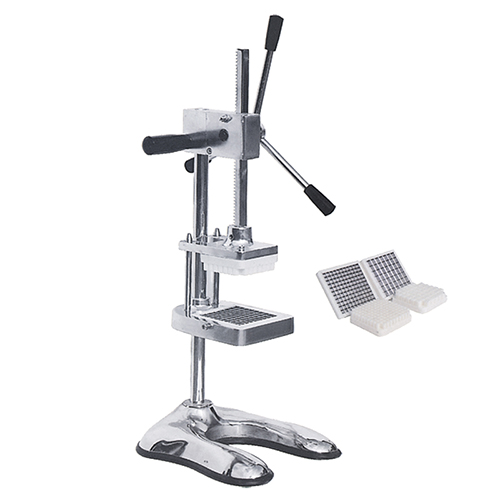
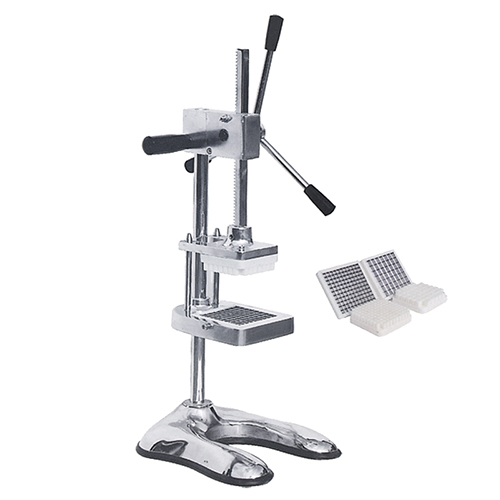
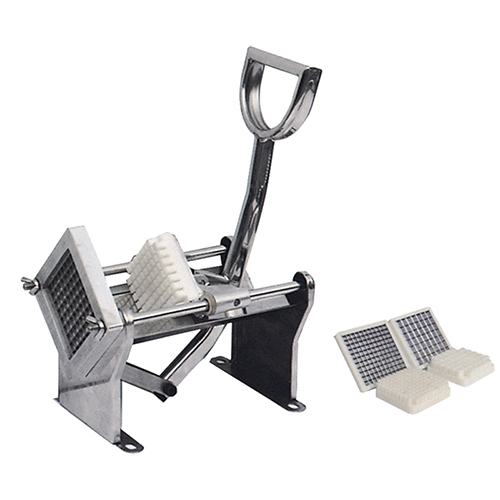
Hand-cutting potatoes into even fries quietly swallows an hour of every prep shift, and that is the small daily problem Ningbo Sybo Machinery Co., Ltd. set out to remove. Trading worldwide as SYBO, the Ningbo manufacturer has spent more than 25 years exporting commercial food machinery, and its Manual French Fry Cutter is one of the most practical answers to that problem: a bench-top, lever-operated tool that presses peeled potatoes into uniform strips without a motor, a plug or an installation visit. Aluminum keeps the frame light enough to lift with one hand, food-grade stainless steel keeps every food-contact surface clean, and three interchangeable blade grids give one machine three different fry sizes.
- No Power NeededFully manual operation
- 3 Blade Grids8×8 / 10×10 / 12×12 mm
- 6 kg PortableEasy to carry and store
- CE & RoHSCore product range
What It Does
This is a preparation tool rather than a powered appliance. Every strip it produces comes from a long lever, a hardened cutting grid and the operator's own weight, which is why it keeps working in places where a motor cannot. Three tasks cover almost everything it is bought for.
- Whole potatoes into even fries. A peeled potato drops into the chute, the lever comes down once, and a whole potato leaves as a clean block of strips. No sawing motion, no knife skills and no bruised knuckles.
- Firm vegetables, not only potatoes. Sweet potato, carrot, cucumber, radish and taro cut just as cleanly, so the machine earns its counter space as general prep equipment instead of a single-dish gadget.
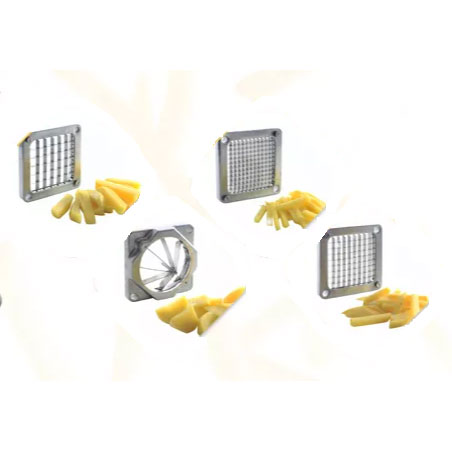
- Three thicknesses on one frame. The 8×8 mm, 10×10 mm and 12×12 mm aluminum grids arrive as standard accessories, covering shoestring sides, standard fries and thick steak-cut chips without a second purchase.
In daily use, the Manual French Fry Cutter replaces a knife, a cutting board and a long stretch of standing at the counter with a single downward motion.
Core Advantages
Buyers rarely choose a machine for one reason. These six points are the ones operators tend to raise after a few months of daily service.
- No electricity, no running cost. There is no motor, no cable and no voltage to match, so the unit works on a cart, in a market stall or in a kitchen where the power supply is unreliable.
- Two materials, each doing its own job. The aluminum frame holds the weight near 6 kg, while the stainless steel surfaces that touch food resist rust, staining and lingering odours.
- Repeatable strips, repeatable frying. Because every strip leaves the same grid at the same thickness, cooking times stop drifting between batches and each portion looks like the last one.
- Breakdown by hand. The grid and pusher lift straight out without tools, leaving smooth surfaces and no hidden crevices where starch can collect.
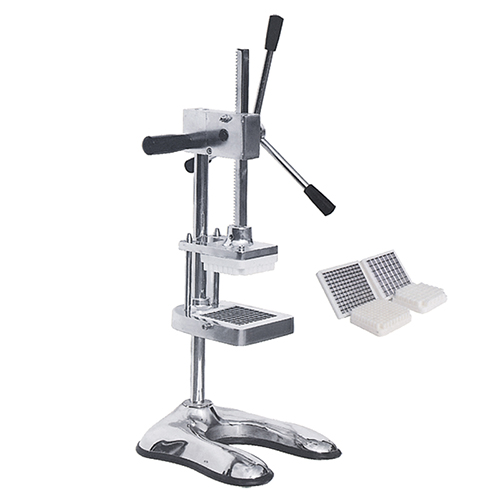
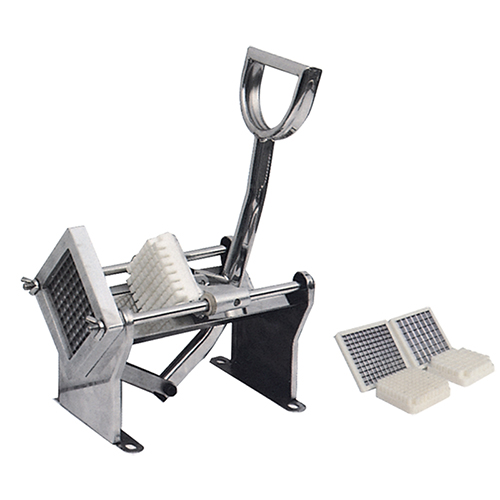
- A small footprint. The CH005 measures only 360×180×250 mm and the CH003 290×230×560 mm, so neither model needs a dedicated prep bench.
- Spare parts that stay available. Blade grids are standard catalogue items rather than seasonal accessories, which matters when a business leans on the machine every morning.
For a counter that has to turn out the same fries at 11 a.m. and again at 9 p.m., the Manual French Fry Cutter is the least expensive form of consistency available.
Specifications
Both models share the same cutting system and the same blade family. The real difference is stance, footprint and how easily the unit travels.
Models and Sizes
| Model | Overall Size (L×W×H) | Net Weight | Gross Weight |
|---|---|---|---|
| CH003 | 290×230×560 mm | 6.0 kg | 6.85 kg |
| CH005 | 360×180×250 mm | 6.0 kg | 6.5 kg |
CH003 stands tall and suits a fixed counter with steady daily volume. CH005 is lower, wider and easier to carry, which is why food carts and market stalls usually prefer it.
Blades and Build
- 8×8 mm grid — thin, crisp shoestring strips for side dishes and toppings.
- 10×10 mm grid — the standard commercial fry, the size most fryers, baskets and menus are built around.
- 12×12 mm grid — thick steak-cut chips with a soft centre and a firm crust.
Body: aluminum frame with food-grade stainless steel contact surfaces. Blade grids: solid aluminum alloy. Power supply: none. Voltage: none, because the unit is entirely manual.
Between the two frames, the three grids and the complete absence of electrical parts, the Manual French Fry Cutter stays a 6 kg tool that fits under a bench and survives a lunch rush.
Where It Works
The machine earns its keep wherever potatoes and firm vegetables are prepared in volume while floor space and power points are in short supply.
- Street food stalls and fry carts — no mains connection, no generator and no noise; the unit is carried in and set up in seconds.
- Snack bars and fast-casual kitchens — one operator can prepare a full service batch before the doors open.
- Cafes and small family restaurants — side dishes of carrot sticks, cucumber batons and sweet potato fries all come from the same machine.
- Catering start-ups and market vendors — a low entry cost with no electrical installation and no service contract to carry.
- Kitchens that lose power — with no motor to fail, prep continues during an outage, which keeps a fry counter trading.
Field note. A stall operator in Southeast Asia moved from cutting potatoes by hand with a kitchen knife to the CH005. The morning prep that used to fill the whole setup period now finishes before the first customer arrives, and switching between the 10×10 mm and 12×12 mm grids lets the stall sell two fry sizes from one unit.
Across every one of those settings, the Manual French Fry Cutter is bought for the same reason: fewer minutes per kilogram of prepared vegetables.
Quality & Support
A tool that is bought once and used every day lives or dies on the paperwork and the spare parts standing behind it. Three things matter most before the order is placed.
- International certifications. CE, RoHS, ETL, LFGB and REACH approvals are held across our core product range, covering the hygiene and safety requirements most import markets ask to see.
- A 25-year export record. Ningbo Sybo Machinery Co., Ltd. sits in Ningbo, Zhejiang, close to Beilun Ocean Port, which keeps freight simple and lead times predictable.
- Blade grids as stock items. Replacement or additional 8×8 mm, 10×10 mm and 12×12 mm grids can be ordered with the machine or later, in single units or in bulk.
Support continues after delivery. Setup is a matter of unpacking, and cleaning, blade changing and everyday care are covered by written instructions and short video walk-throughs. Sample units, specification sheets and pre-shipment inspection can be arranged before a bulk order is confirmed. Warranty terms, spare-part supply and return rules are stated in writing with every quotation, so nothing depends on memory. We also build only this narrow family of manual prep machines rather than trading whatever is in season, which is why a grid bought today still fits a frame bought three years ago.
For anyone who has to justify the purchase to a manager or an importer, the Manual French Fry Cutter arrives with documents, spare parts and a supplier that has been shipping food machinery for more than two decades.
FAQ
Q and A — the questions buyers ask most often before a first order is placed.
Q: Does it cut sweet potatoes, carrots and cucumber, or only potatoes?
A: All firm, solid vegetables. Sweet potato, carrot, cucumber, radish and taro pass through the same grid, and the hardened aluminum blades are strong enough for dense root crops. Peel the item first and cut it into lengths that fit the chute. Soft, juicy produce such as tomatoes, ripe mango or citrus is not suitable, because the pressure crushes rather than slices.
Q: How long does daily cleaning take, and are tools needed?
A: Under two minutes, with no tools at all. The grid and pusher lift straight out by hand, and the stainless steel surfaces are smooth with no hidden gaps where starch can collect. Rinse the removable parts under running water, wipe the frame, dry and reassemble. The whole routine fits into a normal end-of-shift clean-down.
Q: Which model suits a food cart, CH003 or CH005?
A: CH005 for anything that moves. It is lower, wider, lighter to carry and needs very little counter depth, which is why carts, market stalls and small start-ups usually choose it. CH003 stands taller and works well on a fixed bench in a restaurant or snack shop with steady daily volume. Cutting performance and blade compatibility are identical on both.
Q: Is any power supply, wiring or installation required?
A: None whatsoever. The unit is entirely manual, with no motor, no cable and no voltage to match, so it can be used where no mains connection exists. That also means no electrical maintenance, no power consumption and no risk of equipment sitting idle during an outage.
Q: What is the minimum order quantity, and can a sample be ordered first?
A: A single unit can be supplied as a sample so the cutting action and the finish can be checked directly. Bulk pricing, carton quantities and mixed-model orders are quoted on request, and full specification sheets are provided before an order is confirmed.
Q: How are the units packed and shipped?
A: Each machine is packed individually in a carton with the blade grids protected, and bulk orders are palletised for container loading. Shipments leave from Ningbo, next to Beilun Ocean Port, and we can work with the buyer's own forwarder or arrange freight and export documents on request.
Hot Tags: Commercial French Fry Cutter
Related Category
Bone Saw Machines
Commercial Blender
Commercial Food Chopper
Commercial Potato Peeler
Cutting Mixer Machine
Immersion Blender
Meat Mincer
Meat Slicer
Sausage Filler
Vegetable Cutter
Send Inquiry
Please Feel free to give your inquiry in the form below. We will reply you in 24 hours.