Commercial Double Fryer
Commercial Double Fryer by SYBO puts two independent tanks into one countertop cabinet, 4+4L up to 12+12L, so fish and chips can run on separate oil at separate temperatures. The Ningbo factory keeps baskets, elements and valves common across the range.
Send Inquiry
Product Description
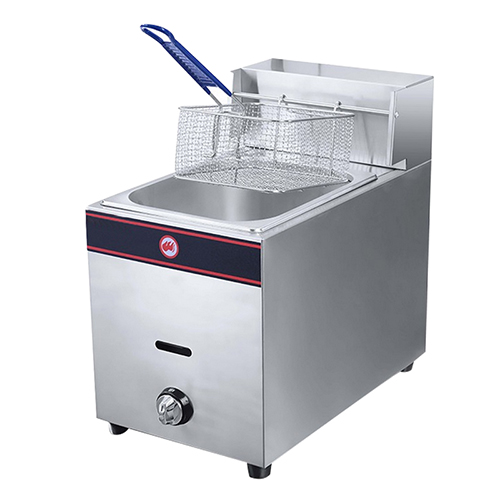
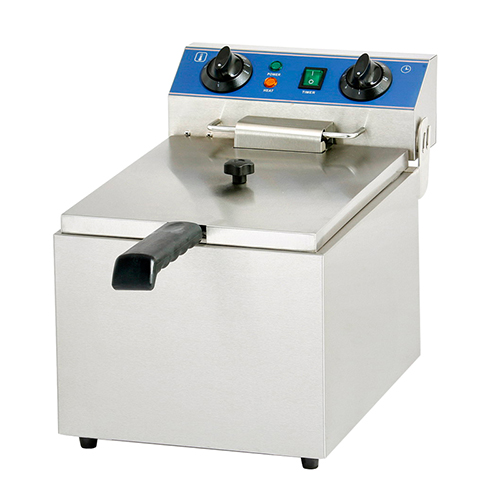
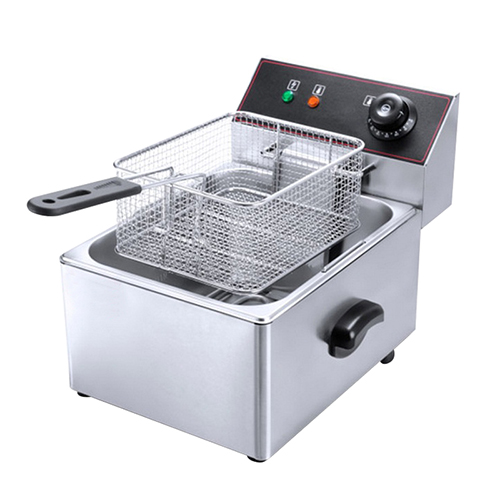
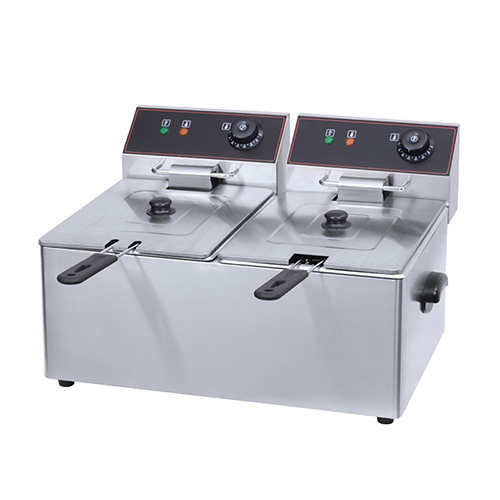
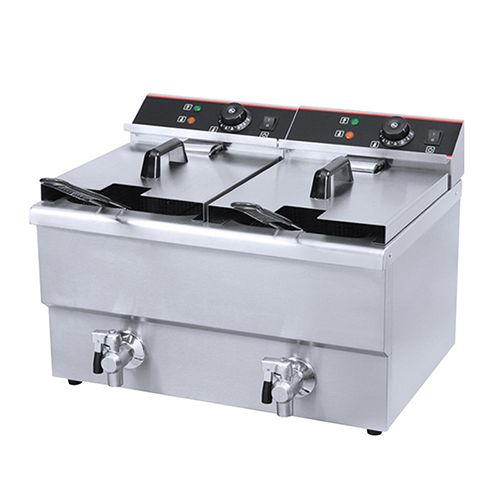
Two frying jobs on one worktop is not a slogan. It is a plumbing and wiring question, and it is the whole difference between a twin unit and a large single tank. SYBO, a Ningbo factory that has built and exported commercial kitchen equipment for more than 25 years, answers it with the Commercial Double Fryer - the version of that idea a small kitchen can actually install: two tanks, two elements, two dials and two drains, sharing one stainless steel cabinet and one metre of counter.
- Tank sizes4+4L up to 12+12L
- HeatingOne element per side
- ControlOne dial per side
- DrainingOne valve per side
- SupplySingle-phase 220-240V
- SparesShared across the range
Twin Circuits
A twin unit is not simply a larger machine. It is two complete oil and heating circuits assembled into one cabinet, which is why it answers a different set of problems from a single tank holding the same total volume of oil.
- Each side carries its own element, thermostat and dial, so the two are set and adjusted independently rather than sharing one temperature across the whole body.
- Each side takes its own basket, so two products can be in the oil at the same moment without being mixed, timed together, or pulled out early to make room for something else.
- Each side has its own drain valve, so the oil on one side can be filtered or replaced while the other side carries on untouched.
The practical effect is that a station stops being one bottleneck with one queue and becomes two that can be worked in parallel. That is what a Commercial Double Fryer is bought for: not more oil, but two independent jobs running at once inside the same footprint.
Peak Capacity
Buyers arrive asking about litres, and usually discover that the case for a second tank has very little to do with capacity and a great deal to do with how a service actually moves.
- Peak rate without a wider footprint. Two tanks in one cabinet deliver roughly twice the batch rate of a single tank of the same size, on the same square of worktop.
- Off-peak economy. Outside the rush one side can be left empty and switched off, so the kitchen is not holding a full body of oil at temperature for the occasional order.
- A station that does not stop. If one side is drained for filtering, or waiting on a spare, the other still produces - which matters far more than the price difference the first time it happens.
Set against that list, the question stops being whether the kitchen can manage with one tank and becomes what it costs on the day the one tank it has is unavailable. Where two different products run through the same service, a Commercial Double Fryer is usually the cheaper machine to own, because the purchase price is the smaller of the two numbers.
Specifications
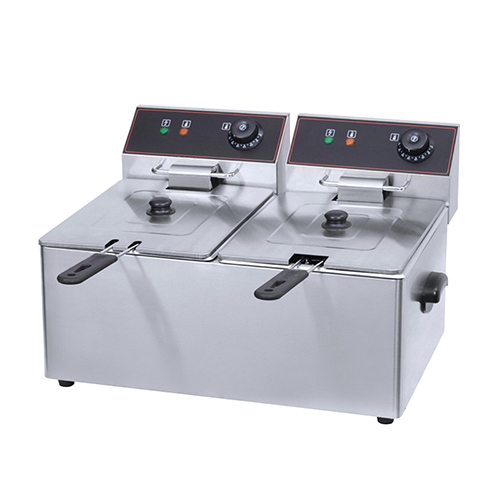
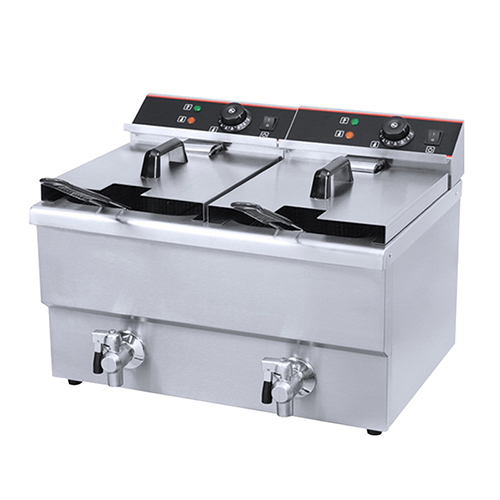
Five twin models are built on the same design as the single tank range, each one simply carrying two of everything. All five run on single-phase 220-240V, so the decision is how much oil each side should hold.
Model Range
| Model | Power per tank | Voltage | Capacity | Dimensions (L x W x H) | N.W. |
|---|---|---|---|---|---|
| HEF-4L-2 | 2.0 + 2.0 kW | 220-240V | 4 + 4 L | 490 x 385 x 320 mm | 9.2 kg |
| HEF-6L-2 | 2.5 + 2.5 kW | 220-240V | 6 + 6 L | 590 x 385 x 320 mm | 10.2 kg |
| HEF-8L-2 | 2.8 + 2.8 kW | 220-240V | 8 + 8 L | 592 x 410 x 340 mm | 11.0 kg |
| HEF-11L-2 | 3.2 + 3.2 kW | 220-240V | 11 + 11 L | 725 x 440 x 345 mm | 15.0 kg |
| HEF-12L-2 | 3.25 + 3.25 kW | 220-240V | 12 + 12 L | 580 x 550 x 410 mm | 17.6 kg |
Supply Notes
Size the supply for both sides, not for one
Two tanks mean two elements, so the connected load is the sum of the two - roughly 4.0 kW on the smallest model and 6.5 kW on the largest. The circuit, breaker and cable should be specified against that total rather than against a single tank. Tell us the destination market at the enquiry stage: 110V builds, plug types, cable length, rating plate wording and retail packaging are all produced to order.
Read as a buying guide, the table settles one question: how much oil each side needs. A small shop running two short menus works comfortably from the 4+4L or 6+6L body. A site that keeps both sides loaded through service moves to 8+8L or above, because a fuller tank holds its temperature better between baskets and the next order does not go out pale. Choosing a Commercial Double Fryer is choosing two volumes, not a higher specification tier.
Twin vs Single
The comparison that decides the purchase is rarely between two twin models. It is between one cabinet with two tanks, two cabinets with one each, and a single cabinet holding the same oil in one body.
| Question | One tank | Two tanks |
|---|---|---|
| Jobs at once | One, worked in sequence | Two, worked in parallel |
| Flavour and oil | Everything shares one body of oil | Separate oil, no transfer between sides |
| Quiet periods | Whole tank stays at temperature | One side can sit empty and off |
| Filtering or a fault | Station stops | Other side keeps producing |
| Counter space per job | Baseline | Less than two separate cabinets |
Which Way to Split
Two single cabinets and one twin cabinet carry the same oil and fry the same volume, and the difference between them is redundancy rather than output. Two separate units survive a fault or a repair on one without touching the other, and they can be installed at opposite ends of a kitchen. One twin cabinet needs one connection, one footprint and one delivery, and it is the only realistic answer when the counter simply has no room for a second machine.
Where the twin format is the wrong purchase is worth saying plainly. A site that fries one product line at a steady rate, or that has both the floor space and the volume to justify a floor-standing station, is better served by a single countertop tank - with a twin unit, the second side would simply sit cold. The honest test is whether a second frying job exists for most of the day rather than only in the busiest hour, and on that test a Commercial Double Fryer either removes a queue or wastes a tank.
Parts & Service
Two tanks mean two elements, two thermostats and two drains, so the sensible question before ordering is not whether a part will eventually need replacing, but whether the replacement will still be on the shelf when it does.
- Common parts across the range. Elements, thermostats, baskets and drain valves are shared between the single and twin models, so a kitchen running both needs one set of spares rather than two.
- Wear items held as service parts. Baskets, elements, thermostats and drain valves for the models we build are kept available after the sale instead of being treated as one-off components.
- Maintenance without losing the station. Drain one side first and the other stays in service, which turns a filter change from a lost evening into a twenty-minute job.
What an operator actually wants from a twin unit is not a longer feature list but a station that stays available. That is why the selection help offered before the order matters as much as the parts support after it: how much oil each side needs, whether a second tank is genuinely justified, and what the site's supply will carry. A Commercial Double Fryer is worth owning when both of those conversations happen before the machine is built rather than after it is installed.
FAQ
QWhen does a second tank actually pay for itself?
AWhen two frying jobs genuinely run side by side for most of the day. That usually means a coating and a plain product that must not share oil, or two menus held at two temperatures on one counter. If the kitchen fries one product line at a steady rate, a single tank of the same total volume costs less to buy and less to clean.
QCan the two sides be held at different temperatures?
AYes. Each side has its own element, thermostat and dial, so the two are set and adjusted independently. That allows a gentle first pass on one side and a hotter finished fry on the other at the same moment, without lifting baskets between settings or waiting for a single tank to climb or fall.
QHow much more supply capacity does a twin unit need?
ARoughly double the load of the equivalent single tank. Two elements mean the connected total is the sum of both - about 4.0 kW on the smallest model and 6.5 kW on the largest. Size the circuit, breaker and cable against that total rather than against one tank, and have a qualified electrician work from the rating plate.
QCan I leave one side empty and switched off?
AYes, and plenty of kitchens do exactly that outside the rush. Each side is switched and controlled on its own, so one tank can sit empty and cold while the other works normally. That is also why a twin unit is not simply paying twice for oil - the second side is only in use when there is work for it.
QIs there any transfer of flavour between the sides?
ANo. The two are separate bodies of oil with no shared circulation, so aromas and flavours do not pass between them. That separation is the main reason fish, spiced items and strongly flavoured coatings are given their own side, and it is also why one tank can be reserved for allergen-free or vegetarian frying without any risk of cross-contact.
QDoes cleaning take twice as long?
AMore work, but not double, because the routine is identical and it happens once per shift. Each side has its own drain valve and removable basket, so both can be drained and filtered one after the other without dismantling anything, and the inner tanks lift out for washing. Draining one side first leaves the other in service while that is done.
QWhich spare parts are kept after the sale?
ABaskets, elements, thermostats and drain valves are held as service parts for the models we build, and they are common across the single and twin ranges. Voltage, plug type, cable, rating plate wording and packaging are produced to the destination market, single units can be supplied for evaluation, and mixed containers can be put together from the wider kitchen and bakery range.
Hot Tags: Commercial Double Fryer
Related Category
Commercial Griddle
Commercial Hot Dog Grill
Commercial Rotisserie Oven
Shawarma Broiler
Commercial Fryer
Send Inquiry
Please Feel free to give your inquiry in the form below. We will reply you in 24 hours.