
Commercial Gas Deep Fryer
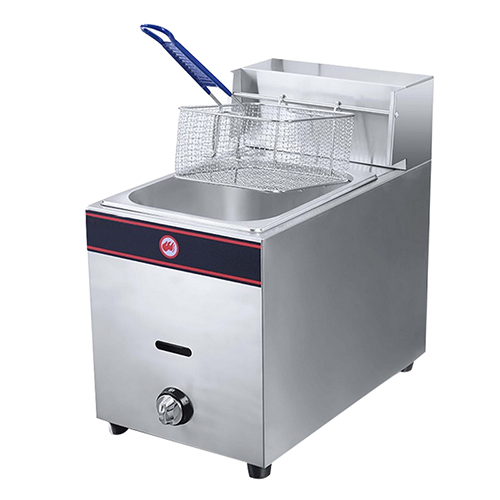
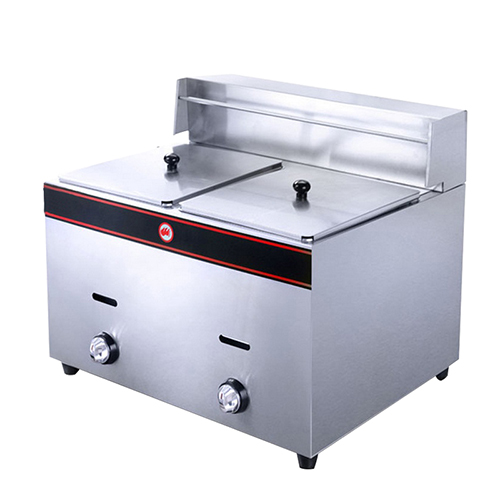
Commercial Gas Deep Fryer by SYBO spans five bodies, a 6-litre countertop unit up to a 14+14-litre floor-standing model, so a high-volume kitchen can match the tank to its busiest hour. The Ningbo manufacturer fixes the gas type at order and ships from Beilun port.
Send Inquiry
Product Description
Gas is normally the cheaper way to hold a large body of oil at temperature, and that single advantage is also the reason a gas machine has to be planned around the building instead of the building around the machine. The Commercial Gas Deep Fryer from SYBO covers the whole size range - five models, from a 6-litre countertop body to a 14+14-litre floor-standing unit - and it comes from a Ningbo manufacturer with more than 25 years of export behind it.
Heat From Outside
Nothing electrical sits in the oil. A burner fires into a tube that passes through the tank, the flame heats the tube, and the tube heats the oil around it. Because the heat arrives through a wall rather than through an element dropped into the tank, the oil never meets a live component.
- Burner and heat tube. The flame stays outside the oil and travels through a stainless tube running inside the tank, so the heat is delivered where the food is without the ignition being anywhere near it.
- Nothing live in the tank. The electrical side of the machine covers ignition and controls only, which is why a gas unit does not need the heavy dedicated circuit that a high-output electric machine of the same size does.
- No element to replace. The parts that wear - burner, thermostatic control, drain fittings - are serviceable without disturbing the tank itself.
That arrangement is the reason gas is chosen where the station runs for hours at a time. The heat source sits outside the oil, the worn parts can be reached, and the tank stays a tank. A Commercial Gas Deep Fryer is specified for exactly that combination rather than for a longer list of features.
Fuel Economics
Where gas wins is not the purchase price. It is the cost of the heat, and the honest way to judge it is against your own utility rates rather than a general rule.
- Cost per unit of heat. Normally lower on gas than on electricity, and the advantage grows with the size of the tank, which is why the case is strongest on the larger models.
- Recovery under load. Burner output brings the oil back quickly after a cold basket, which matters more on a large tank than on a small one.
- Oil life. Holding a steady temperature rather than swinging widely is what slows oil breakdown, and oil is the largest running cost of all on any frying station.
Against that, gas brings obligations: a supply of the right type, ventilation that can be approved, and a licensed fitter to connect and commission the machine. Where a site has none of those, electricity is the simpler answer and the electric range is where to look. Where a kitchen already runs gas and fries at volume, the running cost is normally the argument that decides the purchase - and it is the reason a Commercial Gas Deep Fryer pays for its own installation on a long shift.
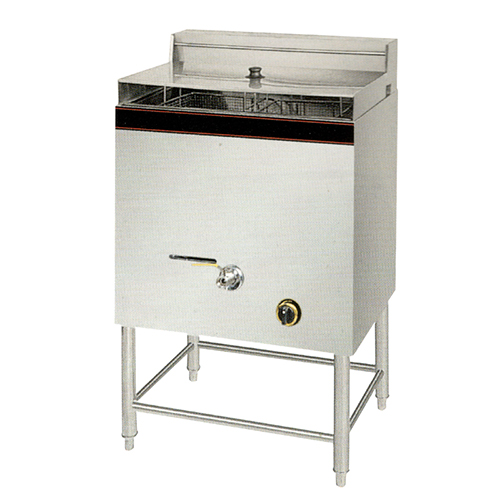
Specifications
Five models cover the range. Burner input varies with the configuration, so the figure to plan around is the one confirmed on the quotation for your unit and printed on its rating plate, alongside the gas type and pressure the machine was built for.
| Model | Capacity | Dimensions (L x W x H) | N.W. |
|---|---|---|---|
| HGF-71 | 6 L | 290 x 520 x 480 mm | 10.8 kg |
| HGF-72 | 6 + 6 L | 570 x 520 x 480 mm | 18.4 kg |
| HGF-73 | 12 L | 550 x 520 x 480 mm | 14.8 kg |
| HGF-74 | 28 L | 590 x 500 x 1060 mm | 32.8 kg |
| HGF-75 | 14 + 14 L | 590 x 500 x 1060 mm | 32.8 kg |
Settle these four before the order
- Which gas the site runs on - LPG or mains natural gas. The burner jets differ, so the gas type is fixed when the order is placed and cannot be swapped on site.
- The supply pressure the installation will actually deliver, because that is what the burner is set to.
- Where the flue and the ventilation will discharge, and who signs that off. In most markets this has to satisfy local code before the machine is commissioned.
- A licensed gas fitter booked to connect and commission the unit, since approval is the step that delays installations most often.
Reading the table is then a question of matching oil volume to the busiest hour rather than to the average day, and of deciding whether the machine stands on a bench or on the floor. Get those two right and the model follows. If a site turns out to be unsuited to gas - no supply, or ventilation that cannot be approved - we will say so and point you at the electric range instead of selling a Commercial Gas Deep Fryer that cannot legally be commissioned.
Bench or Floor
Two body styles sit inside that model list, and the difference between them is height before it is capacity.
Two Body Styles
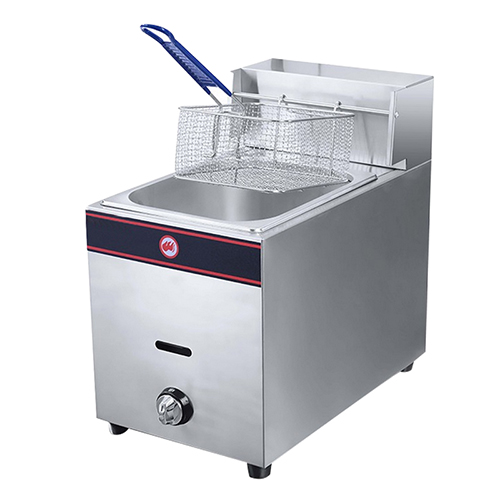
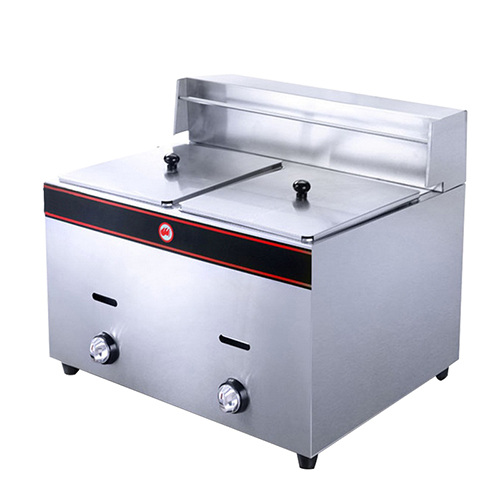
- Countertop bodies, 480 mm high. HGF-71, HGF-72 and HGF-73 run from 6 to 12 litres and are built to stand on an existing bench, where the operator lifts baskets from waist height.
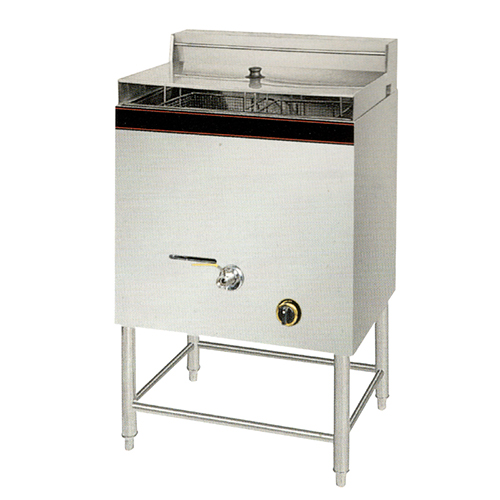
- Floor-standing bodies, 1060 mm high. HGF-74 and HGF-75 carry 28 litres or 14+14 litres, and at that volume working from bench height means lifting a heavy basket far too high; a unit on the floor is both safer and less tiring across a shift.
- A layout answer as well. Where a kitchen has no free bench space, a floor-standing body solves the problem of where the station goes at the same time as the problem of what it carries.
Height and tank size decide it, in that order, and both can be settled from the model list before anything is ordered.
Gas vs Electric
This is the decision that matters most, and it is settled by the building before it is settled by the menu.
- Take gas when the site already has a supply, ventilation can be approved, and the kitchen fries at volume for long stretches - the running cost advantage is largest exactly there.
- Take electric when there is no gas supply, the fit-out has to be all-electric, ventilation is restricted, or the machine has to be working the same day it is delivered.
- Compare the real cost of each. A gas unit needs pipework, a fitter and ventilation; an electric unit of the same output needs a dedicated high-current circuit. Both are installation costs sitting outside the price of the machine.
- Do not compare a small electric countertop model against a large floor-standing gas model. Match the outputs first, then compare running costs.
SYBO builds both, so the recommendation is not tied to what we would rather sell. Tell us the supply, the ventilation that can be approved and the busiest hour, and the answer is usually obvious from those three facts alone. Where a site is genuinely balanced, the deciding factor is normally how many hours a day the machine runs - and the longer the shift, the faster a Commercial Gas Deep Fryer recovers its installation cost.
Fitting & Freight
Installation decides whether the machine goes into service on schedule, so it is worth treating as a small project rather than as a delivery.
- Commissioning on arrival. Burners checked and set to the supply, controls proved, and the operator shown the shut-off before the station is handed over.
- Paperwork prepared for the destination. Packing list, invoice, certificate of origin and any market-specific document are prepared for the country you name, and the rating plate can be produced to the wording a distributor needs.
- One shipment, one port. Goods ship from Ningbo, close to Beilun port, and other equipment from the kitchen and bakery range - mixers, dough sheeters, ovens, griddles - can be added to the same container under one set of export documents.
Day to day the routine is the one every frying station needs: skim the oil, filter it on a schedule, drain fully when the oil is spent. The drain valve empties the tank through a tap rather than requiring the oil to be lifted out, and because heat arrives through a tube there is no element to handle during cleaning. A Commercial Gas Deep Fryer is bought to be planned, installed and then left alone, and it ships with an installation and use sheet so the site knows how it is meant to be run.
FAQ
QCan one unit run on both LPG and mains gas?
ANo. The burner jets differ between the two, so the gas type is fixed when the order is placed and cannot be swapped on site. Tell us which supply the installation will use and the machine is built and set for it. If a site may change supply later, raise it at the enquiry stage, because converting a unit in the field is work for a licensed fitter rather than something the operator can do.
QWhat has to be ready before the machine is delivered?
AThree things: a supply of the right gas type and pressure, ventilation that satisfies local code, and a licensed fitter booked to connect and commission the unit. Approval of the ventilation is the step that delays installations most often, so raise it early with whoever signs off the fit-out. A machine that arrives before the flue is approved simply sits in its crate.
QTwo 6-litre tanks, or one 12-litre tank?
ABoth carry the same oil in total, so the choice is about how the oil is divided. Two tanks let one side be drained, filtered or left idle while the other keeps working, and they allow two products to be held at different temperatures without sharing oil or flavour. A single 12-litre tank is cheaper and has one set of controls and one drain, which suits a station running one product line at a steady rate.
QWhat decides countertop versus floor-standing?
AHeight and tank size, in that order. Countertop bodies stand 480 mm high and run from 6 to 12 litres, which suits a machine on an existing bench. The floor-standing bodies stand 1060 mm high and carry 28 litres or 14+14 litres. At that volume, working from bench height means lifting a heavy basket too high, so a unit on the floor is both safer and less tiring across a long shift.
QHow is the oil temperature held steady?
ABy a dial or panel setting that switches the burner in and out to keep the oil at temperature, rather than letting it drift across a long service. Holding a steady temperature is what produces consistent colour from the first basket to the last, and it is also what slows the oil down, since wide swings are what break oil down early. A clear setting also means a new member of staff can take over the station without learning a technique.
QIs cleaning harder on a gas machine?
ANot if the tank drains properly, which is why the drain valve matters more on a large unit than a small one. Oil leaves through a tap instead of being lifted out in the tank, the basket lifts clear, and because heat is transferred through a tube outside the oil there is no heating element to remove or handle. The routine is the same as any frying station: skim during service, filter on a schedule, drain fully when the oil is spent.
QWhat export documents come with a shipment?
APacking list, invoice, certificate of origin and any market-specific document are prepared for the destination you name, and the rating plate can be produced to the wording a distributor needs. CE, RoHS and LFGB certification is held across our core product range and the relevant documents can be issued with the order. Each unit also ships with an installation and use sheet, and other equipment from the range can travel in the same container.
Hot Tags: Commercial Gas Deep Fryer
Related Category
Commercial Griddle
Commercial Hot Dog Grill
Commercial Rotisserie Oven
Shawarma Broiler
Commercial Fryer
Send Inquiry
Please Feel free to give your inquiry in the form below. We will reply you in 24 hours.